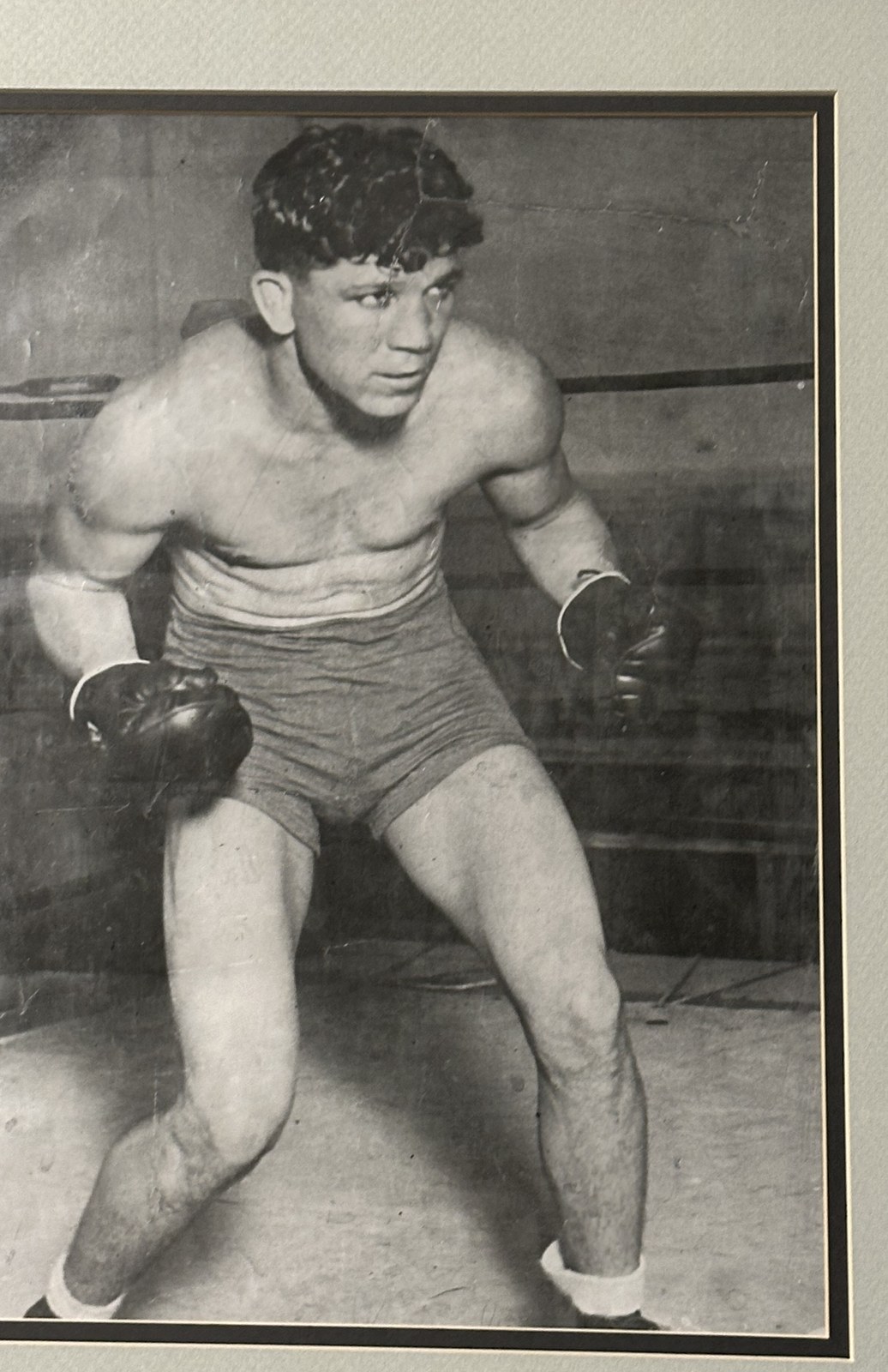
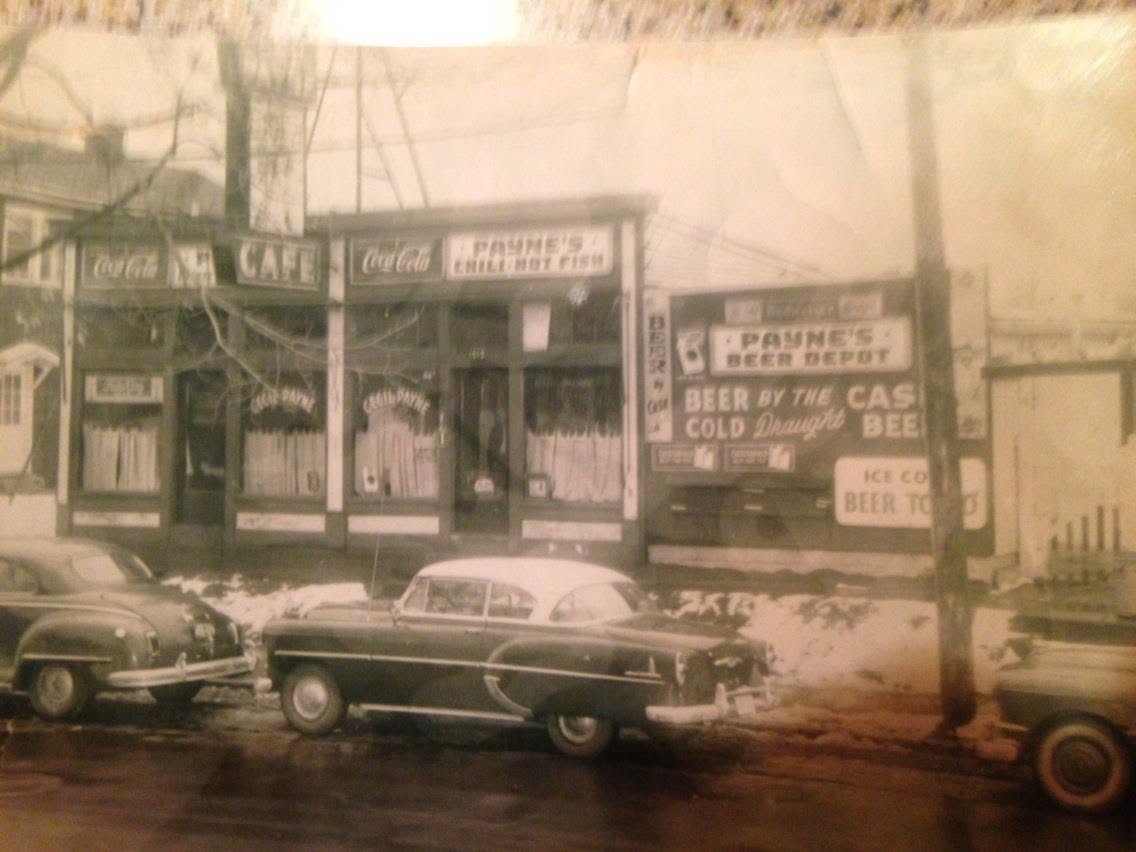
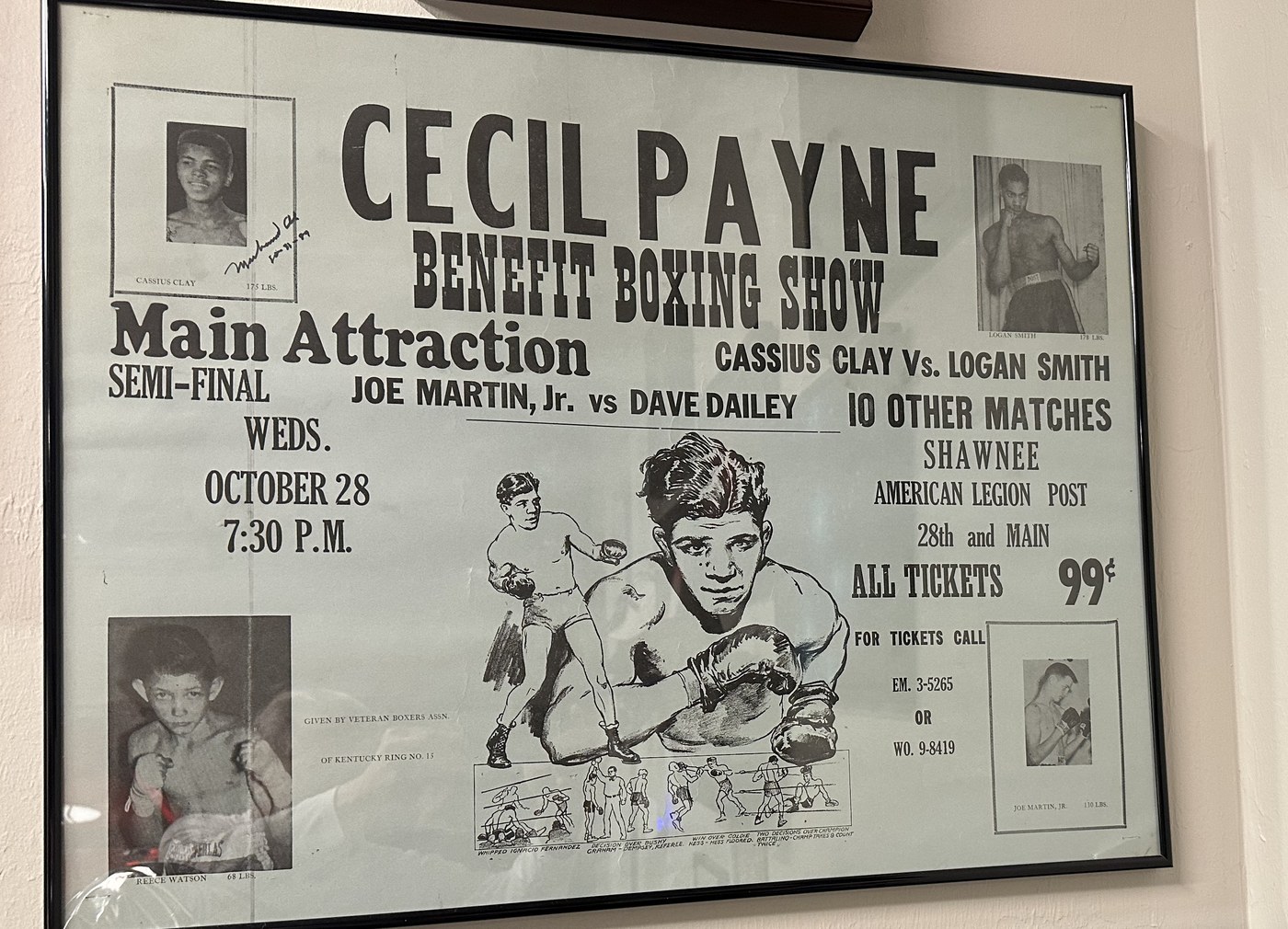
The start was Tennessee. His father was a school teacher, then became a farmer. Apparently not a successful one. Dad (Cecil) had one brother and 5 sisters. At some point all siblings moved to Louisville, presumably for work. It was at that point where teenage dad took up boxing. Louisville was a vibrant boxing city at the time, as were similar cities and since there wasn't even radio then boxing matches were a source of entertainment. We see the boxing career on paper, I don't have much other insight than that. Family memory holds that he also fought for a world featherweight title in Los Angeles; the documentation is not on hand and is still being sought. The 1959 benefit poster shown below also credits him with refereeing a Jack Dempsey fight sometime after his own career ended in 1937 — another detail known so far only from the poster and family memory, and worth putting on the record so anyone who knows more can help fill it in. I do recall old-timers saying he was an entertaining boxer because he fought (ala Ali) with his hands down. After his boxing career he entered the Navy in WWII and was stationed in the Aleutian Islands. His job was to do exercise for the troops in the morning. Said it was easy. I don't believe that he saw any war action, but he has fond memories of sailing to Australia; in my memory I recall he said the Aussies were fun people (shocker!). After the war he rolled out of the navy and settled into Seattle, where it looks like he worked at a bar as a bouncer. He met my mother there on a blind date, married, hence I was born in Seattle. My mom had moved over to Seattle from Libby Montana to work at the Boeing Plant, where she worked on the tail assemblies of planes. She was a Rosie the Riveter. Dad still had family in Louisville and they talked him to moving the family there, and they set him up in a beer joint business, called Cecil Payne's. I have a photo of that. So there's a brief timeline. Blanks can be filled in.
I have sister Celia, 3 yrs younger. We initially moved into an apparent rental home near the old St Joseph's hospital, probably for a year or two. The neighborhood is in fact the St Jo neighborhood. My dad ran the bar, and my mom worked as an ammunition packer in the ammunition plant cross the river in Charlestown, IN. This would have been about 1954. We moved from Seattle when I was 18mos old, I was born December 29, 1951. After a short period of time we moved from that house to a walk-up apartment on 32nd street. The beer joint's address was 1010 S. 32nd street, in the west end of town. It was a one-bedroom apartment above a grocery store with a shared hallway bathroom with other tenants.
In fact the bar was just steps away, right next door to the grocery store, separated by a backyard. After a short time in that apartment we finally purchased a home at 920 S 32nd street. Once again only a few yards, half-a block to the honky-tonk. Because it was a honky-tonk. Listed as Cecil Payne's Cafe, it had an actual bar with spittoons, draft beer (advertised the coldest beer in town), and lots of carry out beer. It had seating for lunch and dinner, with an actual beer garden in the back which was busy on summer weekends. Mom stayed busy cooking, and had a busy lunch crowd with workers from the local furniture manufacturer plant Willets, a few blocks away, and workers from Reynolds Metals, a few blocks the other way.
I have fond memories of that place as a child, and beyond. Recall this is the middle-late 1950's. Country music on the juke box, oiled wooden floors, a fantastic long shuffle-board that was popular with the clientele, by which I saw more than a few fights. And the cigarette smoke. Pervasive. Some Saturday nights we would hire a country music band, and they were loud in such a small place, but it was packed. As an aside before I started grade school I had to get a TB skin test and it was positive. I'm sure from the expectorations from the drunks into the spittoons. That caused a little bit of drama, but in the long run, the public health dept just said I needed to get a CXR, which was negative. However, for my later years hospital employment CXR's were the norm, as a positive PPD was (and is) probably still there.
Life was hard, but good. Parents enrolled us in the local catholic grade school, Holy Cross, where it has a small tuition, but mom thought it worth it. I recall us touring the local public elementary school, Brandeis and Henry Clay, but we all opted for Holy Cross. Made great friends, there and had wonderful teachers, including the nuns, ala The Blues Brothers.
Some of these memories are >70 years old now. I remember dad behind the bar, always wearing a long white apron — that was the style those days. All the clientele were just happy to entertain him in conversation; some of the drunks wanted to test their skills against him, but he always politely declined — until one night the drunken Bud Gatholf (who had a slew of kids living just a couple more doors down on 32nd street) finally took it one tempt too far. Dad stepped out onto the street and one punch crumbled Bud. As they say, FAFO.
I had plenty of friends in the neighborhood. Most of them were at least 2-3 yrs older, and at age 6-7, that's a big deal. It was sporty neighborhood. We played baseball in the sand lot of the home on Greenwood. (It was just a few years later that the mid-60's Louisville riots started at 28th & Greenwood). Baseball was the favorite sport of the kids, and we played a lot; on the sand lot, and in the streets we played Peggy or, against walk up steps. The movie Sandlot exacts our experiences. But, after the world series, street football started, typically 2hand touch on concrete, or all out tackle on the grass. Winter brought basketball. Hoops typically hanging loosely from a garage in the alleys. Games of 1 on 1, or HORSE. Season in, season out. Remember this is basketball country, Kentucky.
The riots will be here — I promise. These were good, hard working families. Blue-collar, uneducated. They worked at the local factories, were construction workers, cab drivers, mail men. This was a rough neighborhood. It was important not to stray too far away alone. But we did venture out, sometimes on bikes if we owned one, or on foot. I have a vivid memory of the first time the older kids invited me to see a movie at a local theatre, The West End. Recall begging my mother to let me go, I was maybe 6, maybe 7. She relented. The movie was The First Man in Space. It scared the hell out of me as the astronaut who returned was a scary monster. The older kids laughed at me because during the movie I just watched the back of the head of the person in front of me. They knew I was scared, and punished me relentlessly. Fast forward several years later, at about age 45 I opted to rid myself of the demons of that movie and found it as a CD rental and re-watched. I saw then why I was scared, because it still has a place in my mind as seared into my brain as images that will never leave.
This is the neighborhood that had the ice cream guy on a bicycle, the "Strawberry Man" selling fruits on his mobile carts, yelling "Strawberries, Strawberries!". Also had the black junk man — One-armed Turner and his mule. Turner had blue eyes. He and his mule patrolled the alleys. Oh the alleys. We had plenty of them. Seemed the grid in the west end was set up such that all homes had access to an alley — I presume it was to accept coal deliveries during the earlier days. The alley was the certain and perfect respite for the 7-11 year olds. Of course nothing good ever happened there, but it was all perfect.
Turner was a loud, scary man. Nice to the kids. He would stop in the tavern occasionally to grab a beer. One time I saw him tell a story of an incident he got involved in, and with one quick movement with his one arm pulled out a switch-blade faster than an eye blink. Respect. In those days we had milk delivered to the front door. So we had milk men too. The tavern was the local gathering place, so the kids when not in the sandlot or in the alley would gather on the stoop and shoot the breeze. Life as an 8 year old was good. We even formed a gang: The 32nd Street Hell Cats. I'm sure I'm the only one who remembers that. We didn't do much gang stuff though, and within a week it was forgotten as a band of tough guys.
In the Spring of '59 dad got sick. Mom took him to Dr Ryan, the long-time PCP. In fact he delivered Celia. Initial diagnosis was the flu. The illness hung on; dad kept working. Finally Dr Ryan said let's do a blood test. Initial diagnosis was that the white count was elevated, might be leukemia. Of course we were (mom primarily) stunned. But a week later, Dr Ryan called and said it looks like that was a mistake, and everything was fine. I recall her sense of relief. However that was a false alarm, further testing confirmed acute leukemia.
Occasional hospitalizations at the VAMC on Zorn ave, then back home to work, then back to the hospital. This went on for a few months. I distinctly remember riding with my dad around town, tracking down people who had promised him they knew the cure for the disease, and the obvious perception from dad that once he talked to these charlatans, he knew they were full of it. A very distinct memory of one of those car trips on a cold Fall day, probably down by the Ohio River because I heard the fog horns of the boats, in an industrial part of town. Another quack, another disappointment. Like the movie, this scene is etched in my memory.
Young Cassius Clay lived at 33rd and Grand. Just a couple blocks from the joint. His old man was a house painter, flamboyant, and would come in and get drunk. One of the very few black guys who would walk into a place like this. Joe Martin was training Clay, and Cassius would sometimes come into the place when he was 12 or 13 and ask my dad boxing advice.
I'll one-up this story: I wasn't there to witness the event, but my mother was. One day when dad was in the hospital for a prolonged visit, there was a PR event. I can't recall which TV station, but they did an event where Clay visited my dad in the hospital — older popular Louisville fighter, speaking with the up and coming new fighter. A feel-good story about the importance of boxing in the city. As my mom related it, when asked what he thought about Clay after he left, my dad said that he was a nice young man, a good boxer, but will never make anything happen, because he talked too much! The Louisville Lip was called out by dad. So much for what dads know.
The poster in my possession is one of three I know of. My sister Celia has one; I saw a third on eBay some years ago. Mine was a Christmas gift from Celia in the 1970s. She knew Ali used to hang out at Joe's Palm Room, the jazz club at 19th and Jefferson, but she didn't know where it was — so she and her husband Vert went together, into a part of town neither of them navigated on their own. She found him. She asked him to sign the poster. Ali looked at it and said he remembered the benefit. He signed it, and then he kissed her on the cheek. And every well-dressed woman in the club — Celia is white, and this was the deep West End on a night out — hollered "Kiss me, Muhammad!" She's laughed about it ever since. I wish I'd seen it.
On October 28, 1959, the Veteran Boxers Association of Kentucky put on a benefit for my father at the Shawnee American Legion Post on 28th and Main. The main event was seventeen-year-old Cassius Clay. My father was in the hospital and couldn't be there. My mother was running the bar and couldn't close it. A neighbor took me. I was seven. I sat ringside and watched Clay demolish a kid, and before the main event someone pulled me up into the ring and introduced me to the crowd. I felt a little sheepish about it. But I remember it as a bright, loud, smoky place, and I remember feeling like I belonged there.
Dad died in the hospital December 1959. Just a few months after the diagnosis. Left mom with two young kids, and a business to run.